
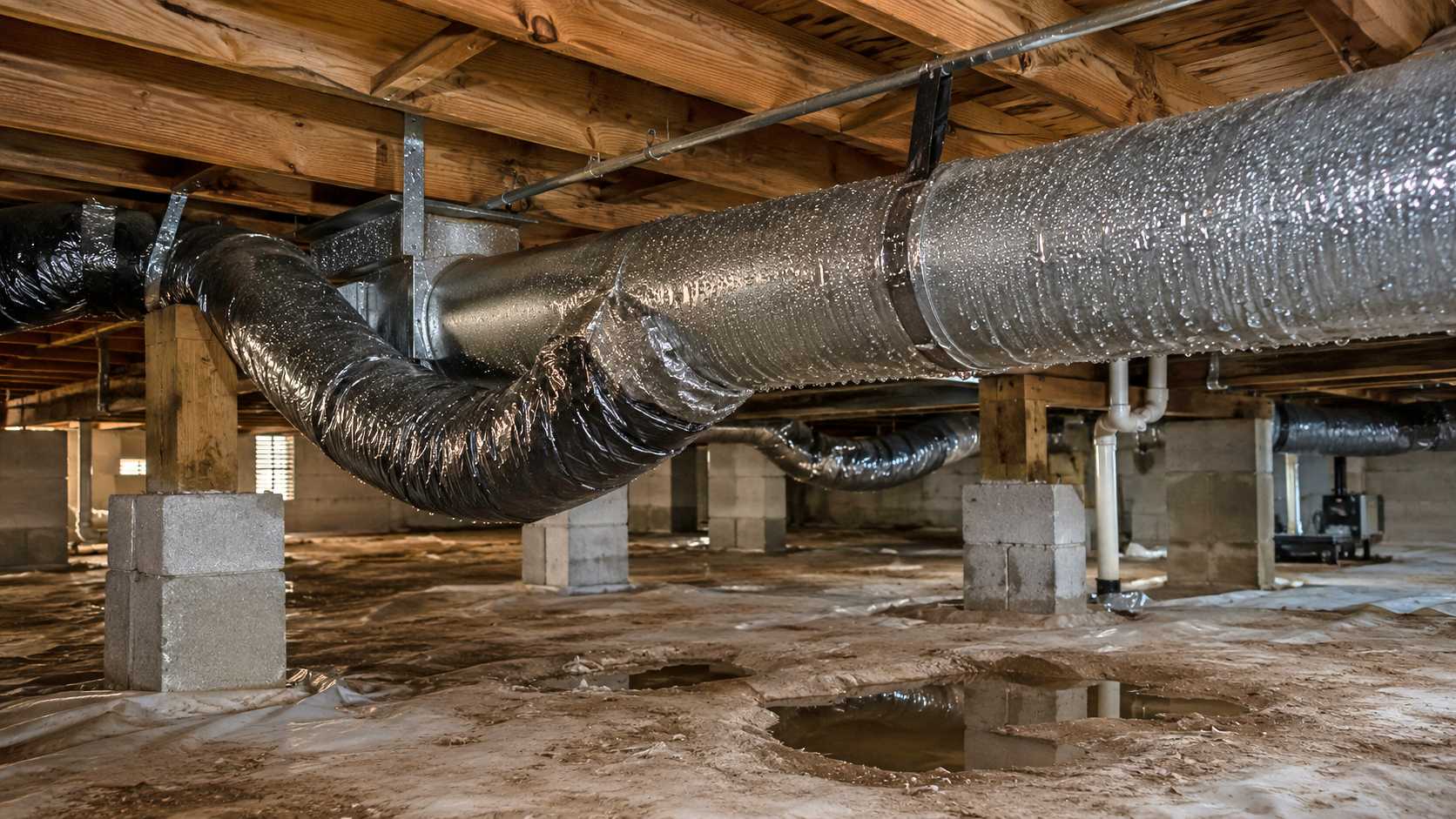
Eliminate Excess Humidity With Crawl Space Waterproofing in Springfield Missouri
Water dripping from HVAC ducts or sagging ductwork in your crawl space might look like an air conditioning leak, but in most cases excess humidity is the real culprit. Addressing excess moisture problems early with crawl space waterproofing helps protect your ductwork, reduces the risk of mold growth, and prevents more extensive damage beneath your home.
-
- Sweating ductwork happens when cold HVAC ducts come into contact with warm, humid crawl space air, causing condensation to form.
- Your crawl space can have dangerously high humidity even without visible standing water or obvious flooding.
- Exposed soil, damaged vapor barriers, poor drainage, groundwater intrusion, open vents, and air leaks all contribute to excess moisture.
- Persistent condensation can soak duct insulation, cause flexible ductwork to sag, reduce insulating performance, and lead to costly repairs.
- Excess moisture creates conditions that encourage mold growth on floor joists, subflooring, insulation, and other materials beneath the home.
- Replacing damaged ductwork without correcting the underlying crawl space humidity problem may only provide a temporary fix.
- Long-term moisture control with crawl space waterproofing may involve crawl space encapsulation, vapor barrier improvements, drainage corrections, air sealing, or a commercial-grade dehumidifier.
- Getting Dog Gone Waterproofing involved sooner rather than later helps identify the true source of the excess moisture before it turns into widespread damage.
- Working with our trusted local Springfield, Missouri waterproofing company provides valuable experience with the humidity, drainage, soil moisture, and crawl space conditions commonly found in Ozarks homes.
Let’s take a closer look at each of these main points in more detail.
Sweating Crawl Space Ductwork Warning Sign of Bigger Moisture Problems
If you’ve ever looked inside your crawl space and noticed water dripping from your HVAC ductwork, damp insulation, or sections of flexible duct hanging lower than they should, your first thought might be that something is leaking from your air conditioner.
But in most cases, your HVAC system is not the real source of the problem. The bigger issue could actually be the excessive humidity inside your crawl space.
Repairing or replacing wet ductwork without addressing the underlying moisture conditions in your crawl space may only provide a temporary fix. If your crawl space remains too humid, these same problems can return and continue affecting your ductwork, insulation, wood framing, indoor air quality, and other parts of your home.
That’s why you need to get our trusted local waterproofing company involved as soon as you notice sweating ductwork or other warning signs beneath your home. The earlier the source of any excess moisture is identified, the better chance you have of this excess humidity turning into extensive damage.
Why Does Crawl Space Ductwork Sweat?
During hot Missouri summers, your air conditioning system sends cool air through ductwork beneath your home. The surface of that ductwork can become significantly colder than the warm, humid air surrounding it inside your crawl space.
When humid air comes into contact with the cold surface of the ductwork, condensation can form. It’s the same reason why a cold glass of iced tea becomes wet on the outside during a hot summer day.
A little temporary condensation might not always indicate a major problem. But frequent dripping, consistently wet duct insulation, visible moisture on nearby building materials, or sagging sections of flexible duct work is not normal.
Those symptoms indicate that the humidity levels inside your crawl space are remaining too high for too long. Simply wiping away the moisture or assuming your air conditioner is working too hard won’t address the underlying cause.
A professional crawl space inspection will determine why so much moisture is accumulating beneath your home. We’ll evaluate your crawl space as a complete environment rather than looking only at the wet ductwork.
Digging deeper is the key to finding the best long-term crawlspace waterproofing solution.
High Crawl Space Humidity Can Exist Without Standing Water
One of the most common misconceptions about crawl space moisture is that you don’t see puddles or flowing water then there isn’t a serious problem.
But that’s not always the case.
Your crawl space can look relatively dry at first glance and still have enough moisture in the air to create ongoing condensation problems. Exposed soil continually releases moisture vapor into your crawl space.
A damaged or poorly installed vapor barrier may not adequately separate the home from ground moisture. Humid outdoor air may enter through open crawl space vents.
Water around the foundation can increase moisture levels even when there is no obvious flooding beneath the house.
Poor grading, inadequate drainage, groundwater intrusion, plumbing leaks, foundation openings, and unwanted air movement between the crawl space and the home can also contribute to elevated humidity.
Homeowners don’t go in their crawl spaces very often and when they do, they naturally tend to focus on the most visible symptoms, such as water dripping from a duct.
But our crawl space moisture professionals look for the conditions that allowed those symptoms to develop in the first place.
Working with our local crawlspace waterproofing company means we understand the moisture challenges that homes in the Ozarks face so we can best evaluate how drainage, soil moisture, seasonal humidity and other property-specific conditions might be contributing to the problem.
Sweating Ductwork Is an Early Warning Sign
Condensation on HVAC ductwork should be taken seriously. It’s telling you that cold duct surfaces are interacting with enough moisture in the surrounding air to create water.
The bigger question that needs to be answered is why.
Catching that warning sign early can make a big difference. Your ductwork can start sweating before major damage has not yet occurred. Addressing the excess moisture at that early stage can help protect insulation, wood framing, subflooring, and other materials from prolonged exposure to moisture.
Waiting and hoping these problems go away just allows them to spread.
What begins as droplets on the outside of a duct can eventually become wet insulation. Damp materials may stay wet longer.
Wood components can be exposed to repeated moisture. Musty odors may begin moving into living areas. Flexible ductwork can become heavy and sag.
All this excess moisture allows mold growth to develop on surrounding organic materials.
Getting us involved earlier gives homeowners a chance to understand the scope of their issues instead of guessing at the best solution.
We’ll help prevent money from being spent on repairs that only address the symptoms while leaving the underlying moisture source untouched.
Condensation Can Damage Flexible HVAC Ductwork
Flexible HVAC ductwork can be particularly vulnerable when exposed to persistent moisture.
A typical flexible duct contains an inner air-carrying section surrounded by insulation, often fiberglass, with an exterior jacket or vapor barrier designed to help protect the assembly. When that outer layer is damaged, poorly sealed, or overwhelmed by persistently humid conditions, moisture can affect the insulation surrounding the duct.
Once insulation becomes wet, the duct assembly can become much heavier. Sections may begin to sag between supports. Water may drip into the crawl space.
Wet insulation can lose some of its effectiveness, making it harder for the ductwork to maintain the desired air temperature as conditioned air moves through the system.
This can create a frustrating cycle for homeowners. They may notice rooms that are harder to cool, assume their air conditioner is failing, call for HVAC work, and replace damaged duct sections without ever addressing the underlying excessive moisture surrounding their system.
In some cases, damaged ductwork absolutely may need professional HVAC repair or replacement. But if the crawl space remains excessively humid, these new materials may once again be exposed to the same conditions.
That is why crawlspace waterproofing and moisture control should be part of the conversation whenever sweating ducts are connected to a damp crawl space.
We’ll help identify whether the environment beneath your home is contributing to repeated water damage and recommend solutions based on the actual source of the moisture.
Moisture Around Ductwork Creates Conditions for Mold Growth
Excess moisture also creates conditions that support mold growth.
Mold may not begin inside the HVAC ductwork itself. Repeated condensation can dampen duct insulation, floor joists, subflooring, wood framing, and other nearby materials.
When moisture remains present long enough, affected areas can become increasingly vulnerable.
Homeowners might realize they have a crawl space problem after noticing a musty odor inside their house. Others discover dark stains, damp insulation, sagging ductwork, or visible mold growth on wood components beneath their floor.
By the time odors are noticeable, the excess moisture issue may have been developing for quite some time.
This is why early action matters. It’s better to investigate excess condensation when the first warning signs appear rather than waiting until multiple parts of your crawl space have been affected.
We focus on identifying and correcting the moisture conditions that can contribute to these problems. Rather than assuming every damp crawl space needs the same treatment, our goal is to understand how excess moisture is entering or accumulating and determine what combination of solutions makes the most sense for your home.
Replacing Wet Ductwork Alone Might Not Solve the Problem
When homeowners see sagging, dripping, or saturated ductwork, replacing the damaged material might seem like the obvious initial solution.
Sometimes replacement is necessary. But it may not be the complete solution.
If high humidity caused the original damage and the excess humidity problems are still present, new ductwork will continue in the same environment.
Cold surfaces will still be surrounded by warm, moisture-laden air. Condensation may begin again, and the homeowner could find themselves dealing with another round of wet insulation and sagging ducts.
This is why solving your underlying crawl space moisture problem is be so important.
Our trusted waterproofing company helps determine whether your home needs a better vapor barrier, a more comprehensive crawl space encapsulation system, drainage improvements, air sealing, groundwater management, or a commercial-grade crawl space dehumidifier.
In some homes, more than one crawlspace waterproofing solution might need to be implemented.
Getting us involved before investing heavily in duct replacement gives you a clearer understanding of the conditions beneath your home.
That information helps you have a more productive conversation with your HVAC contractor if portions of the duct system have been damaged.
Crawl Space Encapsulation Helps Control Moisture
For some homes, crawl space encapsulation is an important part of controlling excessive humidity.
A properly designed crawlspace encapsulation system helps separate your crawl space from moisture sources such as exposed soil and humid outside air.
This typically involves much more than loosely placing plastic over the ground. The effectiveness of your crawlspace encapsulation depends on how well materials are selected, installed, sealed, and integrated with the actual conditions of the home.
This is an area where professional evaluation matters.
Homeowner might see plastic on their crawl space floor and assume their moisture problem has already been addressed.
But an old, torn, undersized, poorly sealed, or improperly installed vapor barrier could still allow significant moisture into the space.
We’ll inspect the existing moisture-control measures and determine whether they are doing the job they were designed for.
A more comprehensive crawlspace encapsulation approach helps create a more controlled environment beneath your home and reduces the conditions that contribute to sweating ductwork.
Dehumidifier Helps. But Entire Crawlspace Should Be Evaluated
A commercial-grade crawl space dehumidifier can play an important role in managing humidity, but simply placing a dehumidifier beneath the home without understanding the source of the moisture might not be the best approach.
If large amounts of water are entering your crawlspace because of poor exterior drainage or groundwater intrusion, the dehumidifier might be asked to solve a problem that should be addressed with other solutions.
If humid outdoor air is continually entering your crawl space, additional crawlspace waterproofing might be necessary to create a more controlled environment.
The best solution depends on your home.
We begin by looking at the conditions to understand why your crawl space is always damp and recommend practical steps to correct the source of the problem and manage humidity over the long term.
Fixing the Problem Early Helps Avoid More Expensive Repairs
Moisture problems rarely become less expensive because they were ignored.
If you notice sweating ductwork, you could be catching the excess moisture problem before extensive deterioration has occurred.
Waiting until duct work is badly sagging, insulation is saturated, odors have spread into the home, or wood materials show visible damage makes the situation more complicated.
Early intervention helps reduce the risk of having to replace larger sections of ductwork. It also helps protect crawl space insulation and structural materials.
It can also give homeowners the opportunity to improve moisture control before mold becomes a bigger concern.
Even when a moisture problem turns out to be minor, knowing what is happening beneath your home is better than wondering whether every new drip, odor, or damp spot is part of a bigger problem.
We help homeowners evaluate crawl spaces early and identify potential moisture sources and explain which issues deserve immediate attention and which improvements may help protect your home over time.
Working With Our Trusted Local Waterproofing Company
Excess crawl space moisture is rarely solved by treating one visible symptom. Every property is different.
The slope of your yard, drainage around the foundation, the age of your home, condition of the vapor barrier, crawl space ventilation, groundwater conditions, and construction details all influence what is happening beneath the floor.
That makes local knowledge and hands-on inspections especially valuable.
We serve homeowners in the Springfield, Missouri area and understand that Ozarks homes face significant moisture and humidity challenges.
Working with our local crawlspace waterproofing company means you’re getting help from professionals who are familiar with the types of crawl spaces, drainage issues, and seasonal moisture conditions commonly found in the Ozarks.
Trust matters because homeowners need honest guidance about what is actually causing your problems.
Sweating ductwork doesn’t mean every crawl space needs the same solution. At Dog Gone Waterproofing, our reputable waterproofing company identifies the source, explains our findings, and recommends improvements based on the conditions of your home.
Don’t Ignore Sweating or Sagging Crawl Space Ductwork
Sweating ductwork, wet insulation, musty odors, and sagging flexible ducts are warning signs that excessive moisture has been building beneath your home.
The longer this high humidity continues, the more opportunities moisture has to affect ductwork, insulation, wood framing, indoor comfort, and other parts of your property.
Replacing damaged materials without controlling the crawl space moisture might only set the stage for future problems to happen again.
We specialize in finding the source of excess crawl space moisture rather than simply covering up the visible symptoms.
Whether your problems involve excessive humidity, poor drainage, groundwater intrusion, a failing vapor barrier, or other moisture-related conditions, we’ll evaluate your crawl space and recommend solutions designed for your home.
If you’ve noticed water dripping from your ductwork, damp insulation, musty odors, sagging ducts, or other signs of excess moisture beneath your home, don’t wait for the damage to become more extensive.
Contact Dog Gone Waterproofing for a professional crawl space inspection.
Getting answers sooner helps you protect your ductwork, your crawl space, and the home above it for many years to come.